Software abstract
For registration of TCM software — Technical Monitoring System
Publication on eLibrary
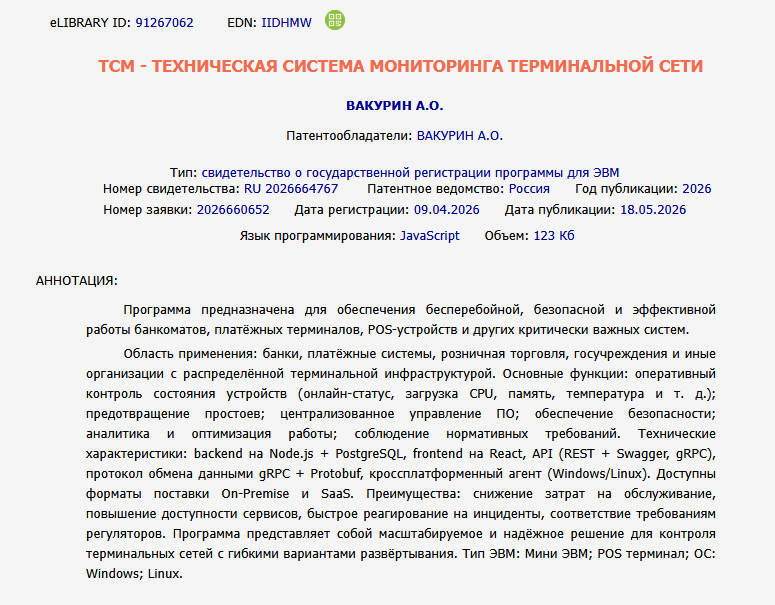
1. Software name
TCM — Technical Monitoring System for Terminal Networks
2. Purpose
The software supports the continuous, secure and efficient operation of ATMs, payment terminals, POS devices and other critical systems.
3. Applications
- Finance: banks and payment systems
- Retail: POS terminals
- Public institutions and other organizations with distributed terminal infrastructure
4. Core capabilities
- Live device status:monitoring connectivity, CPU load, memory, temperature and network connections.
- Downtime prevention:early fault detection, shorter response times and reduced financial losses.
- Software management:centralized updates, remote diagnostics and version tracking.
- Security:attack detection, integrity checks and blocking compromised devices.
- Analytics and optimization:utilization statistics, reporting and capacity planning.
- Compliance:audits, event logs and regulatory compliance.
- Simpler maintenance:remote diagnostics, routine task automation and service request tracking.
5. Technical specifications
5.1. Architecture
- Backend: Node.js (Express, Sequelize), PostgreSQL, Redis, RabbitMQ
- Frontend: React + Vite, Bootstrap
- API:REST with Swagger and gRPC for device communication
- Communication protocol: gRPC + Protocol Buffers (Protobuf)
- Monitoring agent:a cross-platform Node.js application compatible with Windows and Linux
5.2. Deployment options
- On-premise:deployment within the customer infrastructure, full control over data, integration with internal systems such as AD, CRM and SIEM, and support for audits and regulatory requirements. Suitable for banks and public institutions.
- SaaS:fast deployment within hours, automatic updates, flexible pay-as-you-go subscriptions and access from anywhere.
5.3. Communication protocol: gRPC and Protobuf
Benefits:high performance, strong typing, streaming support, compact messages and code generation for multiple languages.
Core messages (.proto):
- DeviceEvent— a device connection or disconnection event
- DeviceInfo— device details: status, model, software version, temperature, battery level and more
- DeviceStatus— status information for one or more devices
- FilePart / FilePartAck— chunked file transfer and delivery acknowledgements
- LogRequest— a log request filtered by type, time, component and severity
- RegistryResponse / RegistryBranchResponse— responses containing device registry settings
- Restart— a device restart command
- TransportMessage— the envelope for all messages, including UUID, session ID, timestamp and payload
gRPC services:
- GetDateTime— request the current device time
- SetDateTime— set the device time
- GetDeviceStatus— retrieve device status
- GetRegistry / GetRegistryBranch / GetRegistryValue— query registry settings
- FilePartStream— bidirectional file transfer stream
- LogRequest— request logs
- DeviceEventStream— connection and disconnection event stream
- RestartDevice— send a restart command
6. Business benefits
- Lower maintenance costs through proactive monitoring
- Higher service availability: more operational terminals and fewer complaints
- Faster incident response through notifications and automated workflows
- Transparent data for analysis and strategic planning
- Support for security and regulatory requirements
7. Key features
- Flexible deployment:on-premise and SaaS support
- Cross-platform support:the agent runs on Windows and Linux
- Efficient communication:gRPC and Protobuf provide compact, fast data transfer
- Scalability:the architecture supports growth as the number of devices increases
- Reliability:CRC32 integrity checks, delivery acknowledgements and streaming for large files and logs
8. Conclusion
The Technical Monitoring System for Terminal Networks provides monitoring and management of distributed terminal devices. Its gRPC/Protobuf communication, on-premise and SaaS deployment options and broad feature set support organizations that depend on continuously available critical infrastructure.